Buy Straw Baler Machine: Complete Guide to Price, Capacity & Selection
javid keshtleyzeri Co.ltd
Buy Straw Baler Machine: Complete Guide to Price, Capacity & Selection
Buying a Straw Baler Machine is not simply a matter of choosing a machine based on its purchase price. For farms, livestock operations, agricultural service centers and commercial straw-processing businesses, the right machine can influence transportation, storage, labor requirements, processing efficiency and long-term operating costs.
This guide explains how to evaluate a straw baler before purchasing, what factors should be considered when comparing machines, and how to organize the complete process from straw collection to baling, packaging, transportation and storage.
Important: The purpose of this guide is to help buyers evaluate their actual requirements before purchasing a Straw Baler Machine. The most suitable machine is not necessarily the cheapest one, but the machine that provides an appropriate balance between capacity, operating conditions, maintenance, support and total cost of ownership.
What Role Does a Straw Baler Machine Play in Agricultural Operations?
After harvesting, straw is often available as a bulky and relatively difficult-to-handle agricultural material. Moving and storing loose straw can require considerable space and additional handling.
A Straw Baler Machine is designed to compress suitable agricultural materials into more organized bales. These bales can then be handled, transported and stored more efficiently.
The overall process can generally be viewed as a sequence of connected operations:
- Straw collection
- Transportation to the processing location
- Feeding the material into the machine
- Compression
- Bale formation
- Packaging or preparation of the bale
- Transportation of finished bales
- Storage and handling
Why Is Straw Collection Important Before Baling?
The performance of a Forage Baler Machine does not depend only on the machine itself. The way straw is collected and delivered to the machine can also influence the efficiency of the overall operation.
Before starting the baling process, the approximate quantity of straw, collection location, transportation route and feeding method should be considered.
If straw is not available when the machine is ready to operate, valuable working time may be lost. For commercial operations, this can become particularly important because machine utilization and labor efficiency directly affect operating costs.
Planning the Location of a Straw Baler Machine
The location where the machine operates should be selected according to the complete workflow rather than the machine alone.
Easy Access for Straw Supply
The route used to move straw to the machine should be practical for the available transportation equipment. A poorly planned route can increase handling time and reduce overall efficiency.
Sufficient Space for Finished Bales
Space should also be available near the bale outlet. Finished bales need to be moved away from the machine so that the production process can continue without unnecessary interruptions.
Transportation to the Storage Area
The distance between the baling location and the storage area should also be considered. A practical layout can simplify internal transportation and bale handling.
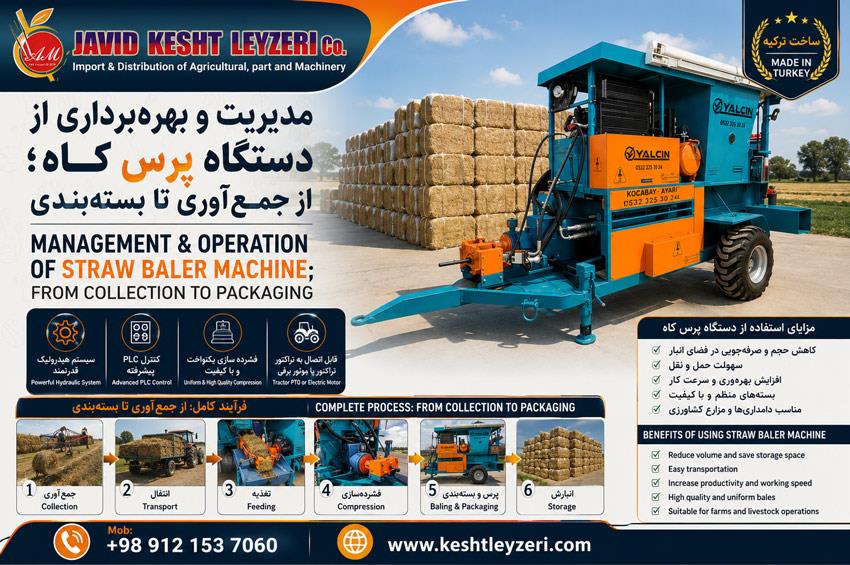
From Straw Collection to Packaging: The Complete Process
Efficient straw baling depends on coordination between several stages. The machine should be considered as one part of the complete agricultural workflow.
| Stage | Main Activity | Operational Objective |
|---|---|---|
| Collection | Gathering straw from the field | Preparing the raw material |
| Transportation | Moving straw to the machine | Maintaining material availability |
| Feeding | Introducing straw into the feeding system | Maintaining a suitable material flow |
| Compression | Compressing the material | Reducing volume and forming the bale |
| Baling | Producing the finished bale | Creating an organized agricultural product |
| Packaging | Preparing the bale for handling | Improving transportation and storage management |
| Storage | Stacking and storing finished bales | Better use of available storage space |
The Importance of the Feeding System in a Straw Baler
The feeding system is an important part of the material flow. According to the technical information previously provided for the YALÇIN Straw Baler Machine, the machine is equipped with a feeding hopper and an internal transfer system for moving dry agricultural material through the baling process.
A consistent supply of material can become particularly important when the machine is operated for extended periods or when large quantities of straw need to be processed.
Therefore, when evaluating a Straw Baler Machine for Sale, buyers should consider not only the compression mechanism but also how material is delivered into the machine.
Tractor PTO or Electric Motor: Why Power Flexibility Matters
The available power source should be considered before purchasing agricultural machinery.
According to the technical information provided for the YALÇIN model, the machine can receive power through a tractor PTO and can also be operated with an electric motor under the specified conditions.
This type of flexibility can be useful because operating conditions vary between farms, livestock facilities, agricultural service centers and fixed processing locations.
Important: Power requirements, PTO specifications, electrical requirements and connection conditions should always be verified against the official technical specifications of the exact machine model before purchase.
How Can You Reduce Downtime During Straw Baling?
Machine speed is only one part of productivity. The complete workflow should be organized so that the machine has a consistent supply of material and finished bales can be moved away efficiently.
Three main flows should be coordinated:
- Material flow: continuous supply of straw to the feeding system.
- Production flow: continuous formation of finished bales.
- Product flow: timely movement of finished bales to transportation or storage.
When these three flows are properly coordinated, unnecessary waiting periods can potentially be reduced.
Managing Straw Bales After They Leave the Machine
The baling process does not end when a bale leaves the machine. Finished bales must be handled, transported and stored in a suitable location.
Bale Handling
Bale handling equipment and methods should be selected according to the dimensions and weight of the finished bales.
Bale Stacking
Organized stacking can make better use of storage space and can make access to stored material easier.
Storage Planning
The storage area should ideally be planned before large-scale baling begins. This becomes increasingly important when significant quantities of straw are processed within a short period.
How Can a Straw Baler Improve Storage Management?
One of the main purposes of baling is to convert bulky agricultural material into more compact and organized bales.
This can simplify handling and storage for livestock farms, agricultural businesses, straw collection centers and commercial packaging operations.
However, the actual storage-space requirement depends on factors such as bale dimensions, stacking method, storage layout and the amount of material being processed.
When Does Using a Straw Baler Make More Operational Sense?
The suitability of a Straw Baler Machine depends on the amount of material being processed and the purpose of the operation.
| Operation | Important Consideration |
|---|---|
| Livestock Farm | Straw consumption, storage and handling requirements |
| Agricultural Farm | Post-harvest collection and material management |
| Straw Collection Center | Material supply and finished-bale handling capacity |
| Forage Packaging Facility | Coordination between feeding, baling, packaging and transport |
| Agricultural Service Company | Machine flexibility and operating conditions at different locations |
| Commercial Straw Business | Capacity, utilization, operating cost and customer demand |
Evaluating Straw Baler Machine Price: Look Beyond the Purchase Cost
Straw Baler Machine Price is naturally one of the first factors considered by buyers. However, the purchase price should not be the only factor used to compare machines.
A more realistic economic evaluation should consider the total cost of operating and maintaining the machine.
- Initial machine purchase cost
- Energy or fuel costs
- Labor requirements
- Routine maintenance
- Repair costs
- Spare parts
- Transportation costs
- Machine utilization throughout the year
Two machines with different purchase prices may have very different operating costs over several years. For this reason, buyers should compare the complete operating picture rather than focusing only on the initial price.
Is Buying a Straw Baler Machine an Investment?
For businesses that regularly process large quantities of straw, a Straw Baler Machine can be considered an important productive asset.
A preliminary economic evaluation can include the expected annual income or savings generated by the machine and the operating costs associated with its use.
These costs may include energy, labor, maintenance, repairs, transportation and other operational expenses.
The actual return on investment depends on the individual business model, workload, machine utilization, operating costs and selling or service conditions.
Who Can Benefit from a Straw Baler Machine?
A Straw Baler Machine can be useful for different agricultural and livestock-related operations, including:
- Livestock farms
- Agricultural farms
- Straw collection centers
- Forage packaging facilities
- Agricultural service companies
- Straw trading businesses
- Commercial straw-baling operations
- Agricultural processing facilities
- Businesses providing straw-baling services
The appropriate machine configuration should always be selected according to the actual material, workload and operating environment.
Why Is After-Sales Service Important When Buying a Straw Baler?
Agricultural machinery may include mechanical, hydraulic, electrical and control components. Continuous operation makes proper service and technical support particularly important.
Therefore, when looking for a Straw Baler for Sale, buyers should evaluate the supplier as well as the machine itself.
Questions to Ask the Supplier
- Are spare parts available?
- Is technical support provided?
- Is operator training available?
- What are the warranty conditions?
- How are replacement parts supplied?
- Is installation or commissioning support available?
Why Are Spare Parts Important for a Straw Baler?
Unexpected downtime can be costly when a machine is used during a busy agricultural season.
Before purchasing a Forage Baler Machine, it is useful to understand which components require regular inspection, which parts may eventually need replacement and how spare parts are supplied.
A reliable spare-parts and maintenance system can contribute to long-term machine availability.
How Should You Compare Two Straw Baler Machines?
Comparing machines only by appearance or purchase price can lead to an incomplete purchasing decision.
A technical comparison should include several important criteria.
| Evaluation Criteria | Machine A | Machine B |
|---|---|---|
| Processing Capacity | Check specifications | Check specifications |
| Baling System | Compare | Compare |
| Power Requirements | Compare | Compare |
| Hydraulic System | Compare | Compare |
| Energy Consumption | Compare | Compare |
| Packaging Configuration | Compare | Compare |
| Warranty | Compare | Compare |
| After-Sales Service | Compare | Compare |
| Spare Parts | Compare | Compare |
| Final Cost | Compare | Compare |
What Information Should You Prepare Before Requesting a Straw Baler Price?
If you want to request a Straw Baler Machine Price, providing detailed information about your application can help the supplier determine a more suitable machine configuration.
- Type of straw or agricultural material
- Approximate quantity of material
- Expected workload per day or season
- Operating location
- Available power source
- Tractor availability, where applicable
- Packaging requirements
- Storage conditions
- Transportation requirements
- Required technical and after-sales support
Common Mistakes When Buying a Straw Baler Machine
1. Choosing Only According to Price
A low purchase price does not automatically mean a lower total cost. Capacity, maintenance, spare parts and after-sales service should also be evaluated.
2. Ignoring Storage Requirements
Finished bales require suitable space for stacking and handling. Storage planning should therefore be part of the purchasing process.
3. Poor Straw Transportation Planning
A baler requires a continuous supply of material. If straw transportation is poorly organized, machine utilization may decrease.
4. Ignoring Technical Support
Technical support and spare-parts availability can become important when the machine is used continuously.
5. Operating the Machine Without Following the Manual
Operators should follow the manufacturer's operating, maintenance and safety instructions for the specific machine model.
Pre-Operation Checklist for a Straw Baler Machine
Before starting the machine, the following points can be reviewed:
- Is sufficient straw prepared?
- Is the machine positioned in a suitable location?
- Is the material transportation route ready?
- Is the required power source available?
- Is enough space available for finished bales?
- Is bale-handling equipment available?
- Is the storage area prepared?
- Is the operator familiar with the machine manual?
- Have the required safety checks been completed?
Technical Overview of the YALÇIN Straw Baler Machine
According to the technical information previously provided for the YALÇIN Straw Baler Machine, the machine is equipped with a feeding hopper and a hydraulic system and can receive power through a tractor PTO or an electric motor under the specified conditions.
The technical test information provided for the machine reports a bale size of 800 × 400 mm, a bale weight of 30 kg and a recorded capacity of 198 bales per hour.
The reported test information also lists a PTO speed of 540 rpm and torque of 181 N·m.
Technical note: These figures are based on the technical test information provided for the YALÇIN machine. Actual performance can vary depending on material characteristics, machine settings, operating conditions, power source and other field conditions.
Is a Straw Baler the Same as a Forage Baler?
The terms Straw Baler Machine and Forage Baler Machine may sometimes be used for related agricultural equipment, but the exact material being processed is important.
Straw and different types of forage can have different physical characteristics. Therefore, buyers should confirm that the selected machine is suitable for the exact material they intend to process.
Before purchasing, it is recommended to provide the supplier with information about the material and the expected operating conditions.
What Should You Ask Before Buying a Straw Baler?
Before completing a purchase, ask the supplier for the following information:
- Exact machine model
- Manufacturer
- Country of manufacture
- Technical specifications
- Processing capacity
- Power requirements
- Installation requirements
- Warranty conditions
- After-sales service
- Spare-parts availability
- Operator training
- Transportation and delivery conditions
- Final purchase price
- Payment conditions
Having this information makes it easier to compare different Straw Baler for Sale offers on a like-for-like basis.
Why the Cheapest Straw Baler Is Not Always the Best Choice
The lowest purchase price does not necessarily represent the lowest long-term cost.
Higher downtime, difficult spare-parts availability, frequent maintenance, unsuitable capacity or higher operating expenses can reduce the economic advantage of a cheaper machine.
Therefore, instead of searching only for the cheapest Straw Baler Machine, buyers should look for a machine that is appropriate for their workload and operating conditions.
How Can You Improve Straw Baler Productivity?
Productivity should not be measured only by the maximum theoretical speed of the machine.
Real-world productivity is influenced by the complete workflow:
Material supply + machine operation + bale handling + transportation + maintenance + operator efficiency
A machine that operates continuously under suitable conditions may provide better practical productivity than a machine with a higher nominal capacity but frequent interruptions.
Maintenance and Long-Term Operation of a Straw Baler
Like other agricultural machinery, a Straw Baler Machine requires appropriate inspection, maintenance and servicing.
Mechanical, hydraulic and electrical components should be inspected according to the manufacturer's maintenance recommendations and the actual operating conditions of the machine.
Regular maintenance can help identify potential problems before they become more serious and can contribute to reliable long-term operation.
Final Guide to Buying a Straw Baler Machine
Choosing the right Straw Baler Machine should begin with the actual requirements of the farm or business.
Livestock farms may focus more on annual straw consumption, storage requirements and handling. Commercial businesses may place greater emphasis on capacity, utilization, processing time, operating costs, reliability and after-sales support.
When comparing Straw Baler Machine Price, remember that the initial purchase price is only one part of the overall economic evaluation.
Energy, labor, maintenance, spare parts, transportation and machine utilization should also be considered.
Ultimately, the right machine is the one that provides an appropriate balance between:
Price + Capacity + Quality + Operating Conditions + Maintenance + Technical Support + Actual Business Requirements
Frequently Asked Questions About Straw Baler Machines
What is a Straw Baler Machine used for?
A Straw Baler Machine is used to compress and prepare straw and certain dry agricultural materials into manageable bales for handling, transportation and storage.
Who can benefit from a Straw Baler Machine?
Straw Baler Machines can be useful for livestock farms, agricultural operations, straw collection centers, forage packaging facilities, agricultural service companies and commercial straw-baling businesses.
What factors affect Straw Baler Machine Price?
Price can depend on the machine model, capacity, technical specifications, power system, equipment, packaging configuration, manufacturer, warranty and after-sales support.
Can the YALÇIN Straw Baler Machine be powered by a tractor?
According to the technical information provided for the YALÇIN machine, it can receive power through a tractor PTO and can also be used with an electric motor under the specified operating conditions.
What information should I provide when requesting a Straw Baler Machine price?
Useful information includes the type of material, approximate workload, operating location, available power source, transportation conditions, storage requirements and packaging requirements.
Is a Straw Baler the same as a Forage Baler?
These terms can refer to related agricultural machinery, but the exact material that the machine is designed and tested to process should always be confirmed with the supplier.
Need Information About Buying a Straw Baler Machine?
If you are looking for information about purchasing a Straw Baler Machine, checking the current price, comparing machine configurations or obtaining technical information about the YALÇIN model, contact Javid Kesht Leyzeri Co.
Phone: +98 912 153 7060
Website: keshtleyzeri.com
Related topics: Straw Baler Machine, Straw Baler Machine Price, Buy Straw Baler Machine, Straw Baler for Sale, Forage Baler Machine, Forage Baler Price, Agricultural Straw Baler, Straw Packaging Machine, Straw Baler YALÇIN
Recent News