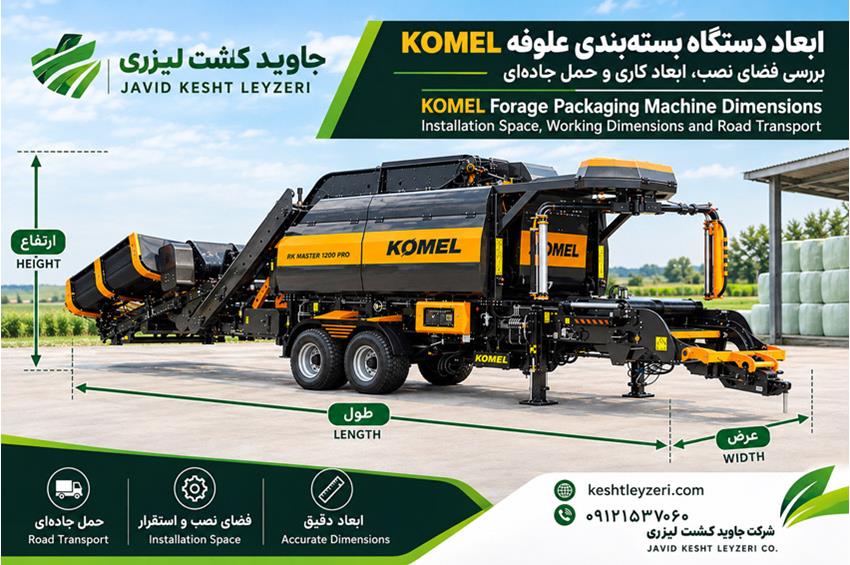
How Much Space Does a KOMEL Forage Packaging Machine Need? Dimensions for Operation, Installation an
Installation Space, Working Clearance and Transport Guide
How Much Space Does a KOMEL Forage Packaging Machine Need? Dimensions for Operation, Installation and Transport
When purchasing a forage packaging and silage machine, production capacity and bale weight are not the only factors to consider. The machine's operating dimensions, road transport dimensions, access route, overhead clearance and installation area are also important.
KOMEL forage packaging machines are available in several models and capacities. Differences in length, width, height and weight affect site preparation, transport planning and the selection of a suitable operating location.
This guide reviews the stated dimensions of the RK MASTER MOBILE 1200, RK MASTER 1200 PRO, RK MASTER 700 PRO, RK MASTER 500 PRO, RK MASTER 200 PRO and RK MASTER 100 PRO models.
Why Should You Check Machine Dimensions Before Purchasing?
A forage packaging machine needs sufficient space for feeding material, compression, wrapping, bale discharge and operator access. A machine may match the required production capacity but still be unsuitable for a site if the access route or working area is too small.
Before purchasing, check whether:
- The machine can pass through the entrance and access route.
- The available width and overhead clearance are sufficient for transport.
- The site has enough room for the machine in its operating configuration.
- A truck or trailer can reach the unloading point.
- There is sufficient room for material feeding, bale discharge and maintenance.
- The ground can safely support the machine and the relevant operating loads.
Operating Dimensions vs. Road Transport Dimensions
Operating dimensions
Operating dimensions describe the machine's length, width and height in its working configuration. They are useful for planning the installation area, material flow, operator access and maintenance space.
Road transport dimensions
Road dimensions refer to the machine's transport configuration. They help with route checks, vehicle selection, entrance clearance and transport planning.
Important: Road dimensions alone do not guarantee that a machine can travel through every route without removing components. Confirm the actual transport configuration, towing connection, route restrictions and applicable transport requirements before shipment.
KOMEL Forage Packaging Machines: Operating Dimensions
All dimensions in the following table are in millimetres.
| Model | Operating Length | Operating Width | Operating Height | Machine Weight |
|---|---|---|---|---|
| RK MASTER MOBILE 1200 | 15000 | 3350–4860 | 3670 | 18800 kg |
| RK MASTER 1200 PRO | 14050 | 3350–4860 | 3350 | 14000 kg |
| RK MASTER 700 PRO | 12750 | 2920–4380 | 3150 | 12000 kg |
| RK MASTER 500 PRO | 12560 | 2920–4380 | 3085 | 10050 kg |
| RK MASTER 200 PRO | 9960 | 2450–3640 | 2660 | 5870 kg |
| RK MASTER 100 PRO | 9645 | 2450–3640 | 2660 | 5000 kg |
Width ranges are reproduced from the supplied specifications. Before designing the final installation layout, confirm the configuration associated with each measurement and identify which components extend during operation.
KOMEL Machine Road Transport Dimensions
Road transport dimensions help with access-route checks, delivery planning and the selection of suitable transport equipment. The following figures are based on the supplied model specifications.
| Model | Road Length | Road Width | Road Height |
|---|---|---|---|
| RK MASTER MOBILE 1200 | 13600 mm | 3000 mm | 3800 mm |
| RK MASTER 1200 PRO | 11750 mm | 2925 mm | 3350 mm |
| RK MASTER 700 PRO | 11525 mm | 2725 mm | 3150 mm |
| RK MASTER 500 PRO | 11040 mm | 2570 mm | 3085 mm |
| RK MASTER 200 PRO | 7000 mm | 2240 mm | 3070 mm |
| RK MASTER 100 PRO | 7000 mm | 2080 mm | 3070 mm |
These figures are useful for preliminary planning. Before arranging transport or preparing an access route, confirm the final dimensions of the specific machine and its exact transport configuration with the supplier or manufacturer.
Machine Weight and Installation Requirements
Machine weight is an important factor when preparing the installation site. According to the supplied specifications, the listed machine weights range from approximately 5000 kg for the RK MASTER 100 PRO to 18800 kg for the RK MASTER MOBILE 1200.
Site selection should therefore consider more than the available floor area. Ground strength, soil conditions, slope, unloading arrangements and access for transport equipment are also relevant.
- Choose a stable, level surface appropriate for the machine load.
- Seek local engineering advice if concrete work or ground reinforcement is required.
- Check the access route for slopes, soft ground and sudden changes in level.
- Provide safe access to serviceable components.
Foundation dimensions, concrete thickness and load-bearing requirements cannot be specified reliably without reviewing the actual ground conditions and machine loads. These should be determined for the individual site.
How Much Installation Space Is Required?
The machine's operating length and width provide a starting point, but the final layout must also allow for material feeding, bale discharge, operator access and maintenance. There is no single installation-area figure that applies to every model and site.
1. Machine footprint
Start with the operating dimensions. Then account for the space required for feeding material, discharging bales, operator access and maintenance. The additional clearance should be based on the actual machine layout and operating method.
2. Material feeding area
Materials such as corn silage, sugar beet pulp, fruit pulp and other green forage crops need to be delivered to the feeding section. Plan the material route, loading position and manoeuvring area in advance.
3. Bale discharge area
Finished bales must be moved away from the machine to storage or transport. Arrange the site so that bale handling does not block the feeding route or operator access.
4. Maintenance access
Mechanical components, wrapping equipment, electrical systems and service points require appropriate access. Determine the necessary clearances according to the manufacturer's instructions and the actual installation conditions.
Checking the Access Route Before Delivery
Even if the installation area is suitable, the machine may be difficult to deliver if the route is restricted. Check the route from the main road to the final installation point.
- Route width: Measure the narrowest gate, road section, bridge or entrance.
- Overhead clearance: Check doors, roofs, cables, pipes and other overhead obstacles.
- Turns and manoeuvring: Overall length alone does not determine whether the machine can negotiate a turn.
- Slopes: Steep gradients and sudden changes in level may complicate delivery.
- Load capacity: Check bridges, paved areas and unpaved routes for the transport vehicle and machine loads.
- Unloading area: Decide where the transport vehicle will stop and how the machine will reach its installation position.
If the route has width, height or turning restrictions, coordinate with the supplier and transport company before dispatch. Published road dimensions do not by themselves guarantee access along a particular route.
Comparing the KOMEL Models
RK MASTER MOBILE 1200
The MOBILE 1200 has a stated operating length of 15 metres, an operating width range of 3.35 to 4.86 metres and a machine weight of 18800 kg. The supplied specifications also mention a 100 kW generator for locations without a suitable electricity supply. Its transport route and installation area require careful planning.
RK MASTER 1200 PRO
This model has a stated operating length of 14.05 metres and a machine weight of 14000 kg. The supplied specifications list 60 kW electrical power and operation with a 140 HP tractor PTO system where electricity is unavailable. Confirm its final transport dimensions before arranging delivery.
RK MASTER 700 PRO
The stated operating length is 12.75 metres and the machine weight is 12000 kg. The listed operating width ranges from 2.92 to 4.38 metres. Allow sufficient space for material feeding, bale discharge and service access.
RK MASTER 500 PRO
The 500 PRO has a stated operating length of 12.56 metres and a machine weight of 10050 kg. Although its bale size and production specifications differ from those of larger models, the full operating dimensions should still be used for site planning.
RK MASTER 200 PRO
According to the supplied specifications, the 200 PRO has an operating length of 9960 mm and a machine weight of 5870 kg. Its stated bale dimensions are 700 by 700 mm. Plan for material feeding and bale handling in addition to the machine footprint.
RK MASTER 100 PRO
The 100 PRO has a stated operating length of 9645 mm and a machine weight of 5000 kg. Its stated bale dimensions are 600 by 600 mm. Even though it is smaller than the larger models, its operating area and delivery route should be checked before purchase.
Pre-Purchase Site Checklist
- The exact machine model and configuration have been identified.
- Operating length, width and height have been checked.
- Road dimensions have been confirmed for the final machine configuration.
- All entrances and route restrictions have been measured.
- Material feeding, bale discharge and maintenance space have been considered.
- Ground stability and levelness have been assessed.
- The transport method, towing vehicle and unloading point have been planned.
- Electrical, generator or PTO requirements have been checked for the selected model.
- Unclear specifications have been confirmed with the supplier or manufacturer.
Buying a KOMEL Forage Packaging Machine from Javid Kesht Leyzeri
Selecting the right machine involves more than bale capacity or hourly output. Operating dimensions, installation space, machine weight, power requirements and transport conditions should all match the needs of your farm, livestock operation or forage production facility.
Javid Kesht Leyzeri supplies KOMEL forage packaging and silage machines. Contact the sales team to enquire about available models, pricing and technical specifications for your intended application.
Website: keshtleyzeri.com
Sales telephone: 09121537060
WhatsApp: Message us on WhatsApp
For more accurate guidance, provide the machine model, installation location, access-route conditions and preferred power source so that the relevant specifications can be reviewed.
Frequently Asked Questions
Are operating dimensions the same as road transport dimensions?
No. Operating dimensions describe the machine in its working configuration, while road dimensions describe its transport configuration. Both should be checked before installation and delivery.
Which KOMEL model requires the most space?
Based on the supplied operating dimensions, the RK MASTER MOBILE 1200 is one of the largest models in this list, with a stated operating length of 15 metres and a maximum listed width of 4.86 metres. The final space requirement depends on the layout, accessories and operating method.
Can a machine be installed inside a building?
This depends on the available height, length, width, access route, ventilation, operating conditions and the manufacturer's instructions. Check the machine dimensions and maintenance clearances before installation in a shed or building.
Is machine length enough to plan transport?
No. Width, height, weight, towing connection, turning radius, route conditions and transport restrictions must also be considered.
Can the installation site be designed using dimensions alone?
No. Material flow, bale discharge, service access, ground strength, access routes and power requirements also affect the layout. The final plan should be based on the specific machine and the actual site conditions.
Conclusion: Before purchasing a KOMEL forage packaging machine, review its operating and road dimensions, weight, delivery route and working area alongside its production capacity. This helps you select a suitable model and reduce potential transport and installation problems.
Recent News