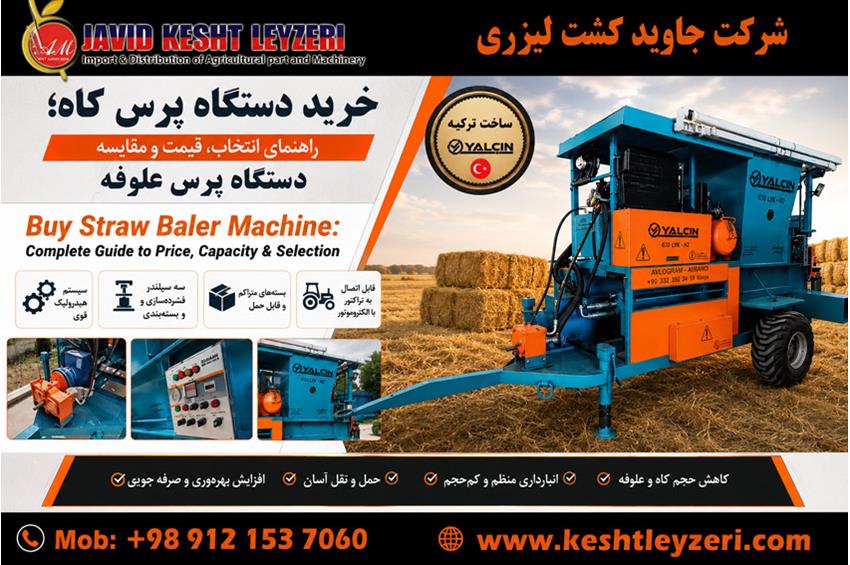
Buy Straw Baler Machine: Complete Guide to Price, Capacity & Selection
javid keshtleyzeri Co.ltd
Buying a Straw Baler Machine: Complete Guide to Selection, Cost, Capacity and Important Considerations
Why Is Choosing the Right Straw Baler Machine Important?
Buying a Straw Baler Machine is not simply a matter of choosing a machine based on its price. When a farm, livestock operation, agricultural center, or straw-processing business handles a significant amount of straw, selecting the right machine can directly affect transportation costs, storage requirements, processing speed, labor requirements, and the overall efficiency of the operation.
For this reason, anyone looking to buy a Straw Baler Machine should determine their actual requirements before comparing machine prices.
For example, a machine suitable for a small livestock farm may not be appropriate for a commercial straw-processing center. Likewise, purchasing a high-capacity industrial machine for a facility that processes only a small amount of straw each year may not provide the best economic return.
Therefore, the main question should not simply be:
"How much does a Straw Baler Machine cost?"
A better question is:
"Which Straw Baler Machine is most suitable for my workload and operating conditions?"
What Should You Consider When Buying a Straw Baler Machine?
Several important factors should be evaluated together when selecting a suitable machine.
1. How Much Straw Will Be Processed?
The first consideration is the amount of straw that needs to be processed.
If your operation is seasonal, determine approximately how much straw needs to be baled during the harvesting season and within what period.
This is important because the required machine capacity should be determined according to the actual workload.
For example, two businesses may both work with wheat straw, but one may only process enough straw for its own livestock operation, while another may collect, bale, package and sell straw commercially.
These two businesses do not have the same machine requirements.
2. Personal Use or Commercial Straw Processing?
Before purchasing a Forage Baler Machine, determine whether the equipment will be used for your own operation or as part of a commercial business.
Straw Baler for Livestock Farms
For a livestock farm, the primary purpose may be to compress straw for easier storage and future use.
In this situation, the following factors can be particularly important:
- Available storage space
- Annual straw consumption
- Number of livestock
- Required straw volume
- Available transportation equipment
Commercial Straw Baling
The requirements are different for a commercial operation.
In this case, processing speed, number of bales produced, operating time, labor costs, electricity or fuel costs, transportation and the ability to handle customer orders become more important.
Therefore, if the objective is selling baled straw or providing straw baling services to other farms, selecting the appropriate machine capacity becomes even more important.
How Can a Straw Baler Reduce Transportation Costs?
Loose straw occupies a large volume.
One of the main reasons for using a Straw Baler Machine is to convert bulky agricultural material into more compact and organized bales.
After baling, the material can become easier to manage during different stages of the logistics process.
This can be particularly important during:
Loading → Transportation → Unloading → Storage → Internal Handling
More organized bales can make planning transportation and storage easier.
However, the actual amount of transportation cost reduction depends on factors such as the transportation method, vehicle capacity, bale weight, transportation distance and loading arrangement. Therefore, there is no single fixed percentage of savings that applies to every operation.
The Importance of Packaging in Baled Straw
Baling straw is not only about reducing volume.
The way the final product is prepared can also affect handling, transportation and storage.
When straw is converted into organized bales, counting, stacking, moving and storing the product can become easier.
For businesses that commercially sell straw, having a consistent and well-organized product can also be beneficial during sales and transportation.
Therefore, when evaluating a Straw Baler Machine for Sale, it is important to determine whether the machine only performs compression and baling or whether additional packaging equipment is included.
Difference Between a Straw Baler for Personal Use and Commercial Operations
A common mistake when purchasing agricultural machinery is focusing only on the machine's stated capacity.
For commercial use, several factors should be evaluated together.
| Evaluation Factor | Personal Use | Commercial Use |
|---|---|---|
| Workload | Usually lower | Usually higher |
| Importance of speed | Moderate | Very important |
| Annual utilization | Lower | Higher |
| Importance of after-sales service | Important | Very important |
| Importance of spare parts | Important | Very important |
| Cost of downtime | More manageable | Potentially expensive |
| Return on investment | Moderate importance | High importance |
| Required capacity | Based on consumption | Based on workload and orders |
Therefore, a machine suitable for a livestock farm is not necessarily the best option for a commercial straw-baling business.
How Should You Evaluate the Straw Baler Machine Price?
Searching for Straw Baler Machine Price is usually one of the first steps buyers take.
However, the price of a machine should not be compared without considering its technical specifications and equipment.
For a more accurate price comparison, evaluate different machines according to:
- Processing capacity
- Baling system
- Hydraulic system
- Power source
- Electric motor or tractor requirements
- Control equipment
- Packaging system
- Component quality
- Country of manufacture
- Technical support
- Warranty
- Spare-parts availability
- Installation and commissioning
- Transportation costs
As a result, two machines that appear similar may have significantly different prices.
Is Buying a Straw Baler Machine an Investment?
For a business that processes a large amount of straw on a regular basis, a Straw Baler Machine can be considered not only agricultural equipment but also a potential income-generating asset.
To evaluate the economics of purchasing the machine, consider the following costs.
Machine Purchase Cost
The initial investment required to purchase the machine is the first major cost.
Energy Cost
Depending on the machine configuration, electricity, fuel or another power source may create ongoing operating expenses.
Labor Cost
The number of people required for feeding, monitoring, handling and managing the machine can affect operating costs.
Maintenance and Repair Costs
Every industrial machine requires periodic inspection, maintenance and, eventually, replacement of certain components.
Transportation Costs
The cost of bringing straw to the processing location and transporting finished bales should also be included in the economic calculation.
Annual Machine Utilization
The more efficiently a machine is utilized throughout the year, the greater the potential for recovering the initial investment. However, actual profitability depends on the operation's real income and expenses.
How Can You Calculate the Return on Investment?
A preliminary calculation can be made using a simple approach.
First, estimate the annual income or savings generated by using the machine.
Then subtract annual operating expenses such as:
- Energy
- Maintenance
- Repairs
- Labor
- Transportation
- Other operating expenses
The result can provide an initial estimate of the machine's economic performance and potential payback period.
The actual calculation should always be based on the specific conditions of each business rather than a fixed figure applied to every buyer.
Who Can Benefit from a Straw Baler Machine?
A Straw Baler Machine can be useful for operations that handle significant amounts of straw and dry agricultural materials.
Potential users include:
- Livestock farms
- Farmers
- Straw collection centers
- Forage packaging facilities
- Agricultural service companies
- Straw trading businesses
- Agricultural processing facilities
- Commercial straw-baling operations
- Businesses providing straw baling services
However, the suitability of a particular machine should always be evaluated according to the type of material, workload and operating conditions.
Why Is After-Sales Service Important When Buying a Straw Baler?
A Straw Baler Machine is not a simple piece of equipment that can be purchased and operated without maintenance.
The machine can include mechanical, hydraulic, electrical and control components. When it is used continuously, proper servicing and technical support become increasingly important.
Therefore, when choosing a supplier, do not evaluate only the initial purchase price.
Important questions include:
Are spare parts readily available?
Is technical support available?
Is operator training provided?
What are the warranty conditions?
How are replacement parts supplied in case of a breakdown?
These issues may seem less important at the time of purchase, but they can become extremely important during long-term operation.
Why Are Spare Parts Important for a Straw Baler Machine?
For machinery that operates continuously, unexpected downtime can create significant costs.
Before purchasing a Straw Baler Machine, it is therefore useful to ask about consumable components and parts that may require replacement during long-term operation.
Hydraulic components, hoses, fittings, moving parts, electrical components and other serviceable parts should be supported by an appropriate maintenance and spare-parts system.
As a result:
The best Straw Baler Machine is not necessarily the cheapest machine. It is the machine that provides the best overall balance between technical performance, operating cost, reliability and after-sales support for your specific application.
How Should You Compare Two Straw Baler Machines?
Instead of comparing machines only by appearance, create a technical comparison table.
For example:
| Evaluation Criteria | Machine 1 | Machine 2 |
|---|---|---|
| Capacity | Check | Check |
| Baling system | Check | Check |
| Hydraulic system | Check | Check |
| Power source | Check | Check |
| Energy consumption | Check | Check |
| Packaging system | Check | Check |
| Machine weight | Check | Check |
| After-sales service | Check | Check |
| Spare parts | Check | Check |
| Warranty | Check | Check |
| Final price | Check | Check |
This approach helps prevent the purchasing decision from being based solely on one specification or the initial price.
What Information Should You Prepare Before Requesting a Straw Baler Price?
If you want to request a Straw Baler Machine Price, it is better to provide the supplier with as much relevant information as possible.
Ideally, prepare the following:
- Type of straw or agricultural material
- Approximate amount of material per day or season
- Location where the machine will operate
- Expected annual utilization
- Availability of a suitable tractor
- Availability of suitable electrical power
- Whether packaging is required
- Desired bale characteristics
- Transportation requirements
- Need for technical training and after-sales support
The more accurate the information, the easier it becomes to determine which machine configuration is appropriate.
Why Should You Not Simply Look for the Cheapest Straw Baler?
The cheapest machine is not necessarily the least expensive option in the long term.
If a machine has higher downtime, more frequent breakdowns, difficult spare-parts availability, higher operating costs or more complicated maintenance, its lower purchase price may not represent a real economic advantage.
Instead of searching only for the cheapest Straw Baler Machine, it is better to search for the most suitable Straw Baler Machine for your workload.
This difference can become particularly important for commercial and industrial operations.
Evaluating a Straw Baler from a Productivity Perspective
Productivity is not simply about machine speed.
A machine can provide better overall productivity when several factors work together:
Processing speed + bale quality + operating stability + low downtime + easy maintenance + spare-parts availability
A machine that operates extremely fast but frequently stops for maintenance may provide lower real-world productivity than a machine that operates at a suitable speed with greater reliability.
For this reason, when selecting a Forage Baler Machine, it is important to evaluate the entire operating process rather than focusing on one technical specification.
Is a Straw Baler the Same as a Forage Baler?
The terms Straw Baler Machine and Forage Baler Machine may sometimes be used for similar agricultural equipment, but the material being processed is an important consideration.
Straw, dry forage and other plant-based materials can have different physical characteristics.
Therefore, when a machine is advertised as a Forage Baler, the buyer should determine which materials the machine is actually designed and tested to process.
Before purchasing, it is recommended to provide the supplier with information about the exact type of material and operating conditions.
What Information Should You Request When Buying a Straw Baler?
If you are looking for a Straw Baler for Sale, obtain the following information from the supplier before making a final decision:
- Exact machine model
- Manufacturer
- Country of manufacture
- Technical specifications
- Processing capacity
- Power requirements
- Installation requirements
- Warranty conditions
- After-sales service
- Spare-parts availability
- Operator training
- Transportation conditions
- Delivery time
- Final purchase price
- Payment conditions
Having this information allows buyers to compare different offers more accurately.
Final Guide to Buying a Straw Baler Machine
Choosing the right Straw Baler Machine should always begin with the actual requirements of the operation.
For livestock farms, annual consumption and storage capacity may be particularly important.
For commercial businesses, capacity, processing speed, operating costs, reliability and after-sales service may have greater importance.
When evaluating the Straw Baler Machine Price, do not consider only the initial purchase price. Energy consumption, maintenance, spare parts, repairs, transportation and annual machine utilization should also be included in the economic evaluation.
Ultimately, a suitable purchase should provide a reasonable balance between:
Price + Capacity + Quality + Equipment + Technical Support + Actual Business Requirements
If you are planning to buy a Straw Baler Machine, Forage Baler Machine, or straw compression and packaging equipment, it is recommended to determine your technical requirements first and then discuss the appropriate machine configuration and current price with the supplier.
Recent News