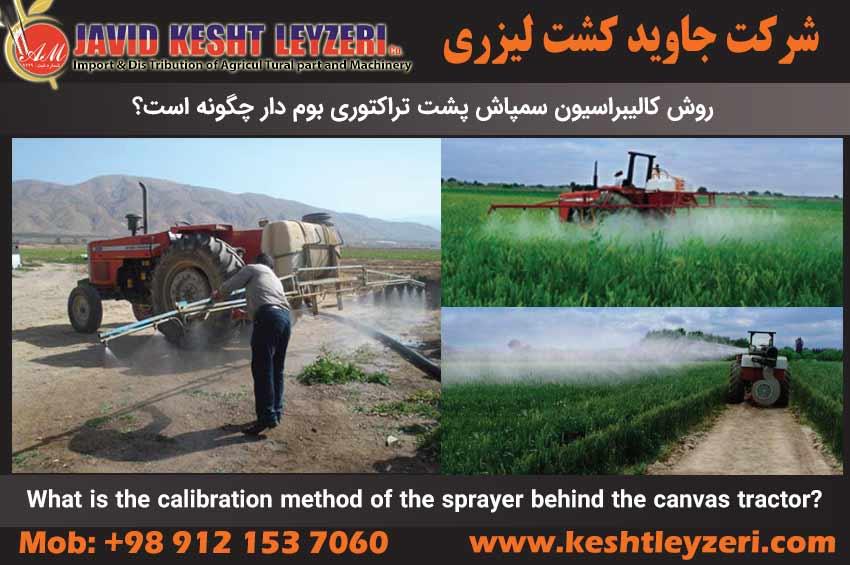
What is the calibration method of the sprayer behind the canvas tractor?
javid keshtleyzeri Co.ltd
List of contents of this section:
What is a sprayer and what is the need for calibration of a boom sprayer?
What is calibration?
What are the steps of calibration of 400 liter sprayers behind Bomdar tractor?
What effect does choosing a nozzle have on the calibration of a canvas sprayer?
What is the effect of adjusting the spraying pressure for the calibration of the boomer sprayer?
How effective is the speed of the tractor in the calibration of the sprayer?
How effective is the consumption of poison solution in spraying one hectare?
How to control the general state of the sprayer in the direction of its calibration?
How does calibration work in the field?
What steps should be taken to calibrate a sprayer behind a boomed tractor?
What is a sprayer and what is the need for calibration of a boom sprayer?
A sprayer is a device that is used to fight against pests and plant diseases and weeds. Sprayers are used on agricultural and garden crops based on the type of use. The sprayers are divided into simple and motorized back sprayers, 100 liter motor, 400, 600, 800 liter tractor back sprayers, both with canvas and lance, and 800 and 2000 liter turboliner sprayers. In terms of precision and overlap, they are among the best sprayers, especially for fighting weeds. Usually, in these sprayers, the nozzles overlap and cover each other two by two. By choosing and using the uniform spraying of the farm surface with a completely suitable nozzle, wind enslavement and poison losses are reduced and the entire surface of the plant is covered with the toxic solution. In our country, due to the lack of leveling of fields, mainly 8-meter canvases are used. The efficiency of a 400-liter sprayer with an 8-meter canvas is about 10 to 15 hectares per day.
What is sprayer calibration?
Calibration is setting the sprayer to spray a certain amount of pure poison or toxic solution per hectare with a predetermined particle diameter and a certain number of particles per square centimeter.
What are the steps of calibration of 400 liter sprayers behind Bomdar tractor?
1- Nozzle selection
2- Spraying pressure
3- The speed of the tractor
4- The amount of solution used per hectare
5- Control the general condition of the sprayer
What effect does choosing a nozzle have on the calibration of a canvas sprayer?
The nozzle is considered as the most critical part of a sprayer, because from it the toxic solution is supplied. The nozzle should be able to convert the solution into fine particles well. To deal with weeds in wheat fields, where the height of the bushes is about 15-20 cm on average and the ground is not completely leveled, the use of nozzle 8002 is highly recommended. This nozzle reduces high spraying height and solution consumption per hectare. If the fields are leveled and the water collection point is close to the field and the volume and height of the product has increased, it is possible to use nozzles 11003 or 11004, which have a low spraying height and high solution.
What is the effect of adjusting the spraying pressure for the calibration of the boomer sprayer?
The pressure in boom sprayers using fan nozzles (T-jet) is usually between 1 and 5 bar. For weed control, a pressure of 2 to 3 bar is usually appropriate, and for pest and disease control, 3 to 4 bar is appropriate. By increasing the pressure, the output of the solution increases and the diameter of the particles is adjusted smaller. In dealing with weeds, coarser particles are used to minimize wind blowing. The pressure change depends on the engine speed and the tractor power take-off (PTO) speed, and its amount is adjusted using a pressure regulator or valve. The term "spray pressure" refers to the pressure behind the nozzle, which is always lower than the pressure at the pump outlet. Therefore, to determine the correct pressure in the nozzles, a pressure gauge can be installed near one of the nozzles.
How effective is the speed of the tractor in the calibration of the sprayer?
The speed of tractor movement in mechanized and completely leveled fields is up to 14 km per hour, which is reduced to 4 to 6 km in our fields due to unevenness (66 to 100 meters per minute).
How effective is the consumption of poison solution in spraying one hectare?
For example, if using the 8002 nozzle with yellow color and at a pressure of 3 bar (PSI 45), also with a moving speed of 5 km per hour, the amount of solution consumption per hectare will be equal to 190 liters. To increase the efficiency and save on the consumption of toxins, prevent plant burn, and reduce the unwanted pollution of the environment and the risks associated with toxins for humans, the calibration operation is carried out using pure water.
How to control the general state of the sprayer in the direction of its calibration?
Before starting the calibration operation, it is necessary to check and control the general condition of the sprayer. In order to ensure the correct operation of the sprayer and perform accurate calibration, the following parts should be checked:
Controlling the amount of solution on both sides of the tank.
Checking the presence of a water-viewing hose (transparent) in front of the degrees on both sides of the tank, especially in tanks that are not visible, to control the amount of toxic solution.
Inspection and control of the net of the tank door basket; This basket should contain 30 mesh and be placed around and under the mesh.
Tank door control.
Checking the leakage of the outlet and return pipes of the solution.
Check for clogging of the strainer under the tank.
Leakage control of all connections from the pump to the nozzle.
Checking the distance of the nozzles on the canvas of 50 cm and the groove of the T-Jet nozzles in a line parallel to the length of the canvas (with an angle of about 1 to 2 degrees).
Ensuring uniform spraying of nozzles with a 50 mesh net and no clogging.
The same flow of nozzles in different sections of canvas and also the same flow of nozzles in one section.
The nozzles are equipped with an anti-check valve to prevent dripping when spraying stops.
Checking the lack of overlap in different parts of the canvas truss, to him
The main hinge.
The presence of height adjustment screws in all parts and their alignment.
Ensuring the same distance of both sides of the boom from the ground when the tractor is standing on the flat.
The movement of the tractor's power axis horizontally in all spraying situations based on the type of nozzle and the height of the product.
If the number of nozzles is 16, the maximum spraying width is 8.5 meters and the useful working width is 8 meters with the distance from the first nozzle to the last nozzle being 7.5 meters.
Cross-folding canvases are preferred over horizontal canvases; Because when it encounters obstacles, as the boom moves back, its head rises and rejects the obstacles.
The size and installation of the connecting hoses should be such that when the barrier is opened, it does not interfere with the spray of the nozzles and does not get stuck between the parts when it is assembled.
At the end of the boom, there should be a U-shaped piece that is responsible for protecting the nozzles and when lowering the boom or hitting obstacles, the nozzles are not damaged.
How does calibration work in the field?
To start the calibration, we pour a certain amount of water (for example, 50 liters) into the tank and then we travel a distance of 250 meters in the field. Then measure the remaining amount of water in the tank after removing the turbulence and subtract it from the initial amount to get the amount of water consumed. For example, if after traveling a distance of 250 meters, the amount of water consumed is 40 liters, with a simple ratio, the amount of water consumed per hectare can be calculated. In other words, if the water used in 2,000 square meters is equal to 40 liters, then the water used in 10,000 square meters will be 200 liters.
2000 square meters = 250 * 8 (canvas width)
So: 200 liters per hectare = (40 / 2000) * 10000
Now, if our target amount is 2 liters of poison per hectare, we can calculate the required amount of poison for a 400-liter tank by using the proportion of its amount. that's mean:
4 liters = (200 / 400) * 2
In this way, the required amount of poison is calculated.
What steps should be taken to calibrate a sprayer behind a boomed tractor?
To calibrate a sprayer behind a boom tractor, you may follow these steps:
Selection of the desired area: It is important to choose an area or testing ground with accurate dimensions to conduct the tests.
Determining the irrigation rate: determine how much water or fertilizer solution you need per unit of land (hectare or square meter).
Pressure Adjustment: Make sure the correct pressure is set for the boom tractor sprayer system.
Canvas width test: Measure the width of the canvas by running irrigation tests along a defined line and ensure that the water or solution is evenly distributed.
Adjusting the spread rate: Calculate the amount of solution used per unit of land and adjust the spread rate of the sprayer according to the needs of the field.
Balance Tests: Adjust the duration and spacing of irrigation lines to ensure that the entire field is irrigated proportionally.
Check the tractor: Make sure the tractor is running smoothly and there are no technical problems or sprayer pipes.
For differences between models and equipment, always refer to the owner's manual for your sprayer and tractor. Also, consulting with local or technical experts can be helpful.
Recent News