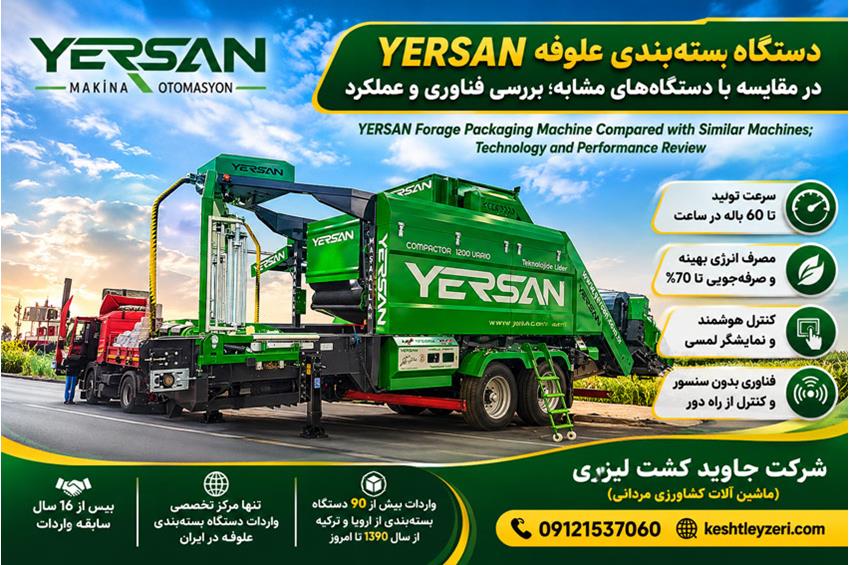
YERSAN Forage Packaging Machine Compared with Similar Machines; Technology and Performance Review
A Technical Review of YERSAN Turkish Round Bale Pressing and Packaging Machine: Technology, Producti
YERSAN Forage Packaging Machine Compared with Similar Machines: Technology and Performance Review
Choosing a forage packaging machine is an important investment for livestock farms, feed producers, agricultural service providers and silage storage businesses. The purchase price is only one part of the decision. Production speed, compression quality, energy requirements, control systems, maintenance costs, spare parts availability and technical support should also be considered.
The YERSAN forage packaging machine from Turkey is a round-bale pressing and packaging system designed to mechanize forage compression and packaging operations. Its announced features include a touchscreen control panel, Wi-Fi connectivity, hydraulic systems, electronic net tension adjustment and sensorless control technology.
This article reviews YERSAN's technology and performance against important criteria used to evaluate similar machines, helping buyers understand its features and determine whether it meets their operational requirements.
1. What Makes the YERSAN Forage Packaging Machine Different?
Forage packaging machines do not all perform the same tasks. Some machines only wrap finished bales with stretch film. Others produce compressed bales and require separate wrapping equipment. Integrated round-bale pressing and packaging machines, such as the YERSAN system, combine several stages of compression, bale transfer and packaging.
A fair comparison must therefore consider machine type, actual capacity, working conditions and the operations performed by each machine. Comparing the output of an integrated baler-wrapper with a standalone bale wrapper without considering their different functions would not provide an accurate result.
One of the important design aspects of YERSAN is the coordination between the pressing chamber, conveyors, bale transfer wagon, net and nylon systems and stretch-wrapping arm.
2. YERSAN Production Speed: Up to 60 Bales per Hour
Production speed is an important factor when purchasing a forage packaging machine. According to information published by YERSAN, the machine can produce up to 60 bales per hour. The manufacturer's comparison refers to approximately 50 bales per hour for certain European machines.
| Comparison criterion | Published figure |
|---|---|
| YERSAN production speed | Up to 60 bales per hour |
| Comparison figure for certain European machines | Approximately 50 bales per hour |
| Calculated average YERSAN cycle time | About 1 minute per bale |
| Calculated comparison cycle time | About 1.2 minutes per bale |
These figures are based on information published by the manufacturer and should not be treated as guaranteed production rates under every operating condition. YERSAN states that packaging time depends on the material and that the published figures were measured during corn silage packaging.
Material type, moisture content, chopping quality, feeding conditions and machine settings can all affect actual output. Buyers should therefore evaluate the machine using the material they intend to process.
3. Electronic Control System and Touchscreen
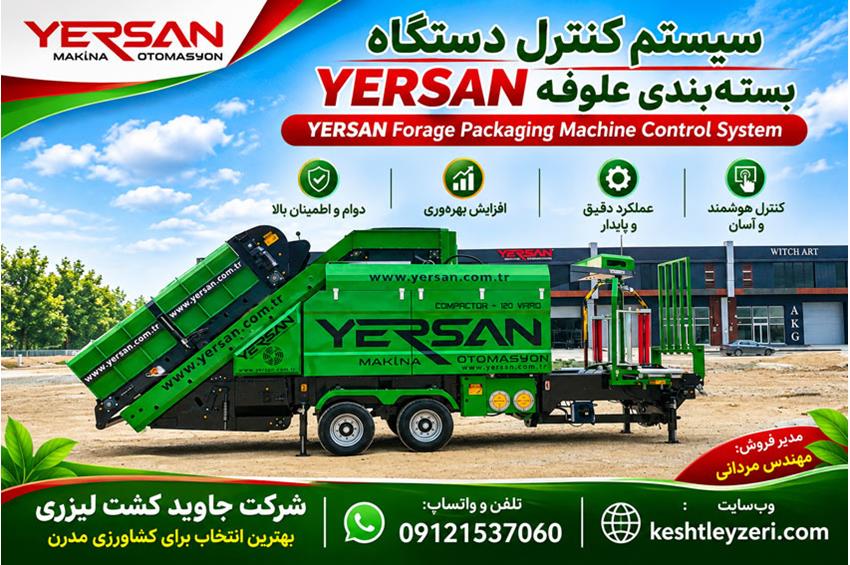
One of the important features of the YERSAN forage packaging machine is its electronic control system and touchscreen panel. The operator can manage different machine sections and separately adjust the speed of the pressing chamber, conveyors, transfer wagon, lower belt and stretch-wrapping arm.
- Separate speed adjustment for different machine sections
- Improved coordination between pressing and packaging operations
- Control through the touchscreen panel
- Reduced need for repeated manual adjustments
- Flexible settings for different materials
According to the manufacturer, the machine's motors use Mitsubishi speed-control systems. The motors also start and stop gradually to reduce sudden mechanical stress on moving components. If a blockage or abnormal load occurs, the system can issue a warning and stop the relevant operation.
4. Remote Machine Control Through Wi-Fi
Another feature announced for the YERSAN machine is the ability to connect to its Wi-Fi network and control it using a mobile phone or tablet. This allows the operator to access compatible control functions through a smart device.
Wi-Fi connectivity can make machine operation and access to control functions more convenient. Before purchasing, buyers should confirm the available remote functions, operating range and connection requirements with the seller.
5. Sensorless Control Technology in the YERSAN Forage Packaging Machine
One of the technologies emphasized by YERSAN is its Sensorless Control system. According to the manufacturer, this technology is used in three main machine sections.
5.1 Sensorless Bale Transfer Wagon Control
Some machine designs use sensors installed along the wagon's travel path to detect its position. YERSAN describes a system that controls the bale transfer wagon without conventional sensors installed along the track.
According to the manufacturer, the wagon position is detected with millimeter-level precision, and the system retains position information even when electrical power is unavailable. This design aims to reduce dependence on exposed track sensors, improve movement control and reduce the risk of sensor damage caused by spilled material.
5.2 Sensorless Pressing Chamber Door Control
The pressing chamber door opens and closes repeatedly during bale production. YERSAN states that its control system identifies the door position without conventional sensors mounted on the door and manages movement speed and pressure according to its position.
The purpose is to provide more controlled movement and reduce mechanical impact during opening and closing.
5.3 Sensorless Stretch Knife Control
The stretch knife is controlled through a pressure-based system, according to YERSAN. The manufacturer states that this arrangement does not rely on conventional mechanical adjustment or separate sensors for detecting the open and closed positions.
Reducing mechanical adjustment points and sensitive components may be useful for maintenance and operating stability. However, the actual effect on breakdown rates should be assessed under working conditions and through maintenance records.
6. Stretch-Break Monitoring System
A broken stretch film can interrupt the wrapping process and result in incomplete bale protection. YERSAN introduces a stretch-break monitoring system to manage this situation.
According to the manufacturer, if one of the two stretch films breaks, the machine automatically increases the remaining wrapping revolutions to complete the process with the remaining film. If both films break, a warning appears on the control panel and the wrapping arm moves to a suitable position.
This feature is designed to reduce the possibility of releasing an incompletely wrapped bale and to limit the need for immediate operator intervention.
7. Electronic Net and Nylon Tension Control
Proper net and nylon tension is important for bale packaging quality. Some machine designs use mechanical braking systems to adjust tension, which may require periodic readjustment as friction and component wear affect performance.
YERSAN uses an electronic braking system for net and nylon tension. The operator can change the tension value through the control panel without relying on conventional mechanical adjustment.
- Net tension adjustment through the control panel
- Reduced need for repeated mechanical adjustment
- Settings can be adapted to net quality
- More consistent wrapping conditions
According to the manufacturer, the selected setting can remain consistent over many bales as long as the net quality remains unchanged.
8. Hydraulic System and Pressing Belt Tension
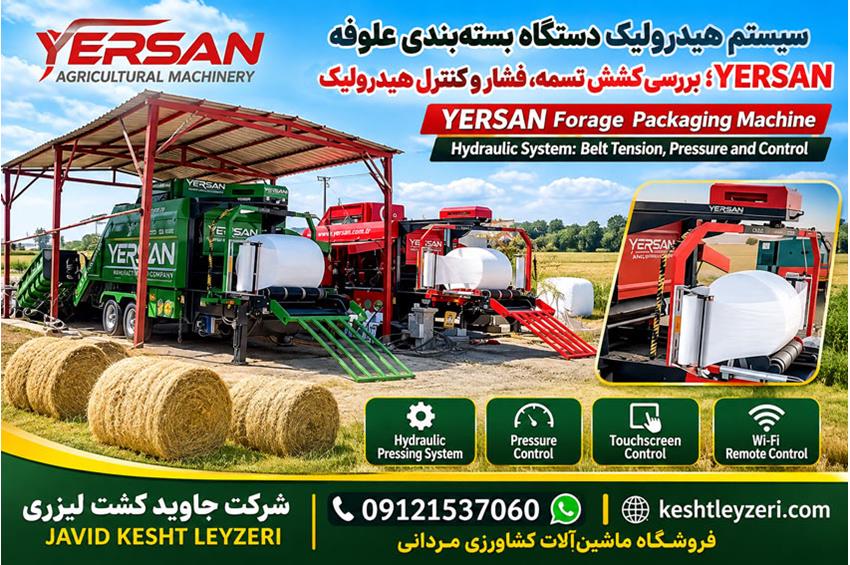
The hydraulic system is an important part of round-bale pressing and packaging machines. In the YERSAN machine, pressing chamber belt tension can be adjusted hydraulically, allowing the operator to change settings according to the material being processed.
Another announced feature is a proportional hydraulic flow and pressure control system. According to the manufacturer, the speed and power of hydraulically operated sections can be adjusted through the control panel. This can help coordinate different machine movements under changing operating conditions.
When comparing hydraulic systems, buyers should also evaluate pump specifications, valves, working pressure, required flow rate and actual machine performance.
9. Running Gear, Chassis and Hydraulic Braking System
The running system is important when a machine needs to be moved between working locations. According to YERSAN, the machine uses a four-wheel, dual-axle scissor-type running system. The manufacturer states an 18-ton capacity for the axle assembly.
The machine is also equipped with a hydraulic braking system controlled through a hydraulic hose connected to the tractor.
Before purchasing, buyers should inspect the chassis, connections, axles, brakes, tires and suitability of the running system for the intended transport conditions.
10. Automatic Lubrication System
Proper lubrication of chains and bearings is important for the service life of moving components. YERSAN describes manual and automatic lubrication options for parts of the pressing chamber.
According to the manufacturer, the system can calculate operating time and perform lubrication at selected intervals. This can help organize maintenance schedules. However, periodic inspection of oil levels, chains, bearings and lubrication lines remains necessary.
11. Loading Material Using a Tipper or Dump Truck
One practical feature of the YERSAN machine is the design of its rear loading conveyor. According to the manufacturer, the conveyor is positioned close to the ground and has a wide layout, allowing material to be fed into the machine by raising the tipper body of a suitable transport vehicle.
This arrangement may be useful for operations that transport chopped forage in dump trucks or similar vehicles. Before purchasing, buyers should check conveyor height, loading dimensions and compatibility with their transport vehicles.
12. Comparing YERSAN with Similar Forage Packaging Machines
To understand the differences between YERSAN and similar machines, buyers should compare technical features and the control methods used in different machine sections. Some forage packaging machines offer program controls, displays, joysticks, film-monitoring systems and hydraulic equipment. However, available features vary according to brand, model and selected equipment.
| Comparison factor | YERSAN | Similar machines |
|---|---|---|
| Production speed | Up to 60 bales per hour, according to the manufacturer | Depends on model, machine type and material |
| Electronic control | Touchscreen with separate speed adjustment | Program controls and joysticks on selected models |
| Remote control | Wi-Fi connection and mobile or tablet control | Remote control or joystick depending on model |
| Wagon position control | Manufacturer-described sensorless technology | Control method depends on machine design |
| Pressing chamber door control | Manufacturer-described sensorless technology | Different control arrangements by model |
| Net tension control | Electronic adjustment through the panel | Mechanical adjustment on some designs |
| Stretch-break management | Management of one- or two-film failure, according to the manufacturer | Film monitoring on selected models |
| Pressing belt tension | Hydraulic adjustment | Depends on machine design |
| Lubrication | Manual and automatic lubrication options | Central lubrication on selected models |
This is a feature-based comparison and does not establish that YERSAN is superior to every other machine. A final evaluation should consider exact model specifications, actual capacity, equipment, maintenance requirements and after-sales support.
Features worth examining in YERSAN include the combination of sensorless control, electronic net tension adjustment, stretch-break management, Wi-Fi connectivity and proportional hydraulic flow and pressure control.
13. Energy Requirements of the YERSAN Forage Packaging Machine
Energy use is an important operating-cost factor when purchasing a forage packaging machine. YERSAN has published power measurements for different stages of corn silage packaging.
| Operating condition | Published power figure |
|---|---|
| Moving packaged material to the stretch-wrapping section | 5.5 kW |
| Filling the pressing chamber | 12 kW |
| Pressing chamber half full | 20 kW |
| Full chamber during net wrapping | 35 kW |
YERSAN also promotes energy savings of up to 70%. This figure should be treated as a manufacturer claim. A definitive comparison with other machines requires comparable test conditions and measurement reports.
The figures in the table represent published power values for different operating conditions. They should not be interpreted as total energy consumption per bale or daily electricity use without knowing the operating time of each stage. Energy consumption depends on both power and operating duration.
14. YERSAN Design and Manufacturing in Turkey
According to the official YERSAN website, the company's experience servicing European agricultural machinery contributed to the development of its round-bale pressing and packaging machines.
The manufacturer states that the machine's design and software were developed by the company and that approximately 90% of the machine is domestically produced in Turkey. YERSAN also reports receiving a test report from Selçuk University Faculty of Agriculture and an agricultural credit certification for its machine.
These details can help buyers understand the manufacturer's technical and production background. Buyers should request relevant technical documents and reports for the exact model they intend to purchase.
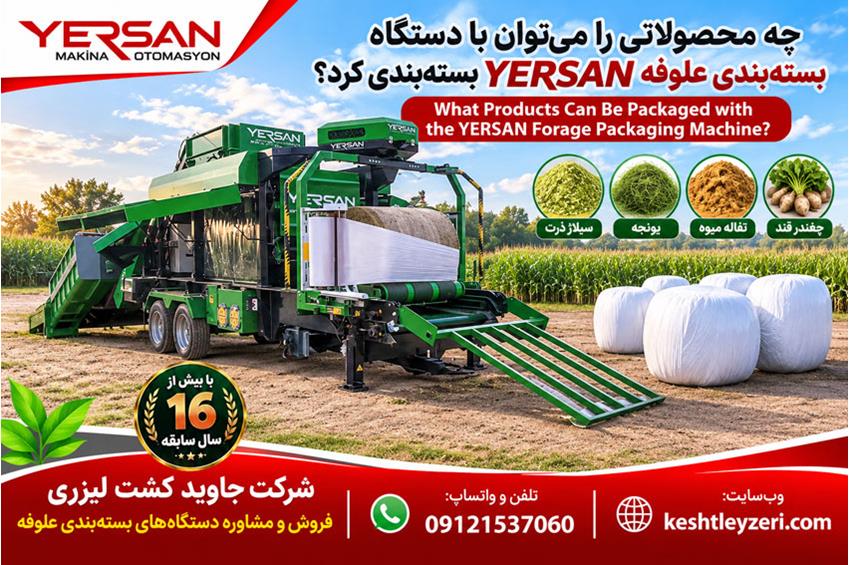
15. What Materials Can the YERSAN Machine Package?
According to the manufacturer, the YERSAN forage packaging machine is designed for several agricultural and feed materials.
Corn Silage
Corn silage is one of the main materials listed for the machine and is widely used in cattle feeding.
Fruit Pulp
Fruit-processing residues and pulp can be packaged for storage and later use.
Sugar Beet Products
Sugar beet processing products are also included among the materials listed by the manufacturer.
Alfalfa
Chopped alfalfa is another material identified for use with the machine and can be packaged for forage storage.
Maximum chopped material length: YERSAN states that chopped material should not exceed 7 cm. Moisture content, chopping consistency and feeding conditions should also be checked before purchase.
16. What Should You Check Before Buying a YERSAN Forage Packaging Machine?
The following checklist can help buyers make a more informed purchasing decision:
- Type of material to be packaged.
- Daily production volume and required capacity.
- Actual machine speed with your material.
- Power requirements at different operating stages.
- Touchscreen and electronic control functions.
- Hydraulic system and pressing belt tension.
- Net and nylon tension control.
- Stretch-break detection and response.
- Chassis, axles, brakes and transport requirements.
- Lubrication system and periodic maintenance costs.
- Availability of consumable and spare parts.
- Technical service and after-sales support.
- Operator training and technical documentation.
- Transportation, installation and commissioning.
- Final price and sales conditions.
17. What Affects the Price of a YERSAN Forage Packaging Machine?
The price of a YERSAN forage packaging machine may depend on the model, equipment configuration, technical specifications, import conditions, transportation costs and sales terms.
Comparing only the initial purchase price is not enough. Buyers should also consider maintenance, consumables, energy, transportation, installation, training and technical support.
Before purchasing, request clear information about machine specifications, included equipment, delivery conditions and after-sales services.
18. Buying a YERSAN Forage Packaging Machine from Javid Kesht Leyzeri
If you are considering buying a YERSAN forage packaging machine from Turkey, selecting the right machine for your operation is essential.
Javid Kesht Leyzeri Company (Mardani Agricultural Machinery Store) specializes in importing and supplying forage packaging machinery.
- More than 90 forage packaging machines imported from Europe and Turkey since 1390 (2011/2012).
- More than 16 years of experience in forage packaging machine imports.
- Specialized activity in importing forage packaging machinery into Iran.
For information about purchasing a YERSAN forage packaging machine, technical specifications, sales conditions and machine selection, contact Engineer Mardani.
Javid Kesht Leyzeri Company
Mardani Agricultural Machinery Store
Sales Manager: Engineer Mardani
Mobile: 09121537060
Website: keshtleyzeri.com
WhatsApp: Contact via WhatsApp
Conclusion: Why Consider the YERSAN Forage Packaging Machine?
The comparison of the YERSAN forage packaging machine with similar machinery shows that its design focuses on automation, electronic control and management of the packaging process.
Manufacturer-published features include production speed of up to 60 bales per hour, touchscreen control, Wi-Fi connectivity, sensorless technology, proportional hydraulic flow and pressure control, electronic net tension adjustment and stretch-break monitoring.
However, the final purchasing decision should be based on material type, required capacity, working conditions, energy requirements, price and technical support. If you are looking for an integrated round-bale pressing and packaging machine with advanced electronic and hydraulic control features, YERSAN is a model worth evaluating.
Contact Javid Kesht Leyzeri and Engineer Mardani for advice on purchasing a YERSAN forage packaging machine.
Frequently Asked Questions About the YERSAN Forage Packaging Machine
What is the production speed of the YERSAN forage packaging machine?
According to the manufacturer, the machine can produce up to approximately 60 bales per hour. This figure was measured during corn silage packaging and may vary with material type and operating conditions.
What are the main differences between YERSAN and similar machines?
The main announced features include sensorless control of the bale wagon and pressing chamber door, electronic net tension adjustment, stretch-break management, hydraulic belt tension and Wi-Fi control.
Can the YERSAN machine be controlled by a mobile phone?
Yes. According to the manufacturer, operators can connect to the machine's Wi-Fi network and control it using a mobile phone or tablet.
Where is sensorless technology used in the YERSAN machine?
The technology is described for bale transfer wagon positioning, pressing chamber door control and stretch knife operation.
What materials can the YERSAN machine package?
The manufacturer lists corn silage, fruit pulp, sugar beet products and alfalfa. Chopped material should not exceed 7 cm in length.
Can the YERSAN machine manage stretch film breakage?
According to the manufacturer, the system monitors stretch film during wrapping and adjusts the remaining revolutions if one film breaks. If both films break, a warning is displayed.
Where can I get information about buying a YERSAN forage packaging machine?
Contact Javid Kesht Leyzeri and Engineer Mardani at 09121537060 for purchasing information and technical consultation.
Recent News