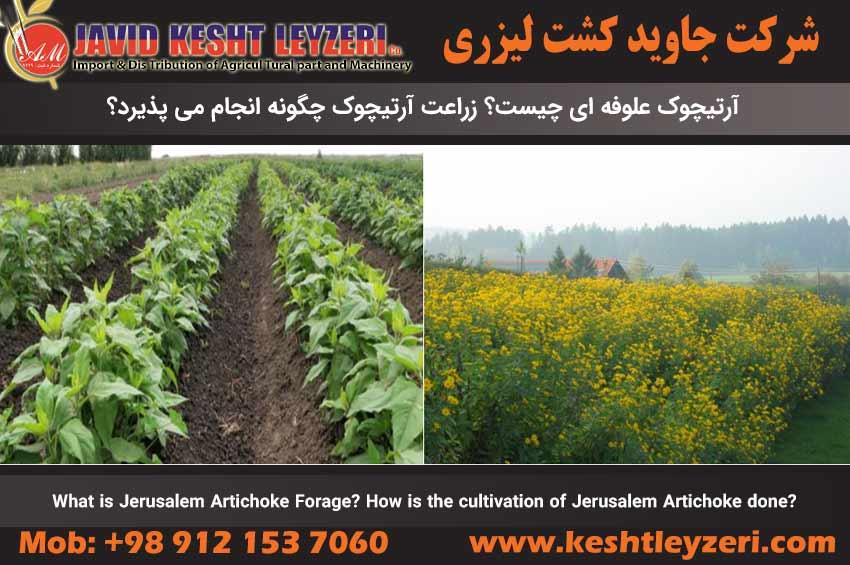
What is Jerusalem Artichoke Forage? How is the cultivation of Jerusalem Artichoke done?
javid keshtleyzeri Co.ltd
List of Contents in this Section:
-
Botanical Specifications of Jerusalem Artichoke:
-
How is Jerusalem Artichoke Cultivated?
-
How is the cultivation of Jerusalem artichoke carried out?
-
How is Jerusalem Artichoke Harvested?
The above topics will be further explored in the following content.
Botanical Specifications of Jerusalem Artichoke:
Jerusalem artichoke, scientifically known as Helianthus tuberosus, belongs to the Asteraceae family and the Helianthus genus. This plant is also recognized by the name "Jerusalem artichoke." The Helianthus genus, including various species, highlights two essential ones: Jerusalem artichoke and sunflower, both prominent in agricultural productions. These plants play a significant role in developing hybrid plants and contribute notably to agricultural product development programs in North America.
Jerusalem artichoke is a perennial plant characterized by robust, rough stems and tubers. It grows vertically and is classified based on the number of stems (single-stemmed, two or three stems, or more than three stems branching from the tuber). Typewise, it can be branchy or non-branchy with wide leaves, connected to the main stem or side branches.
Due to the appropriate connection of its aerial parts, Jerusalem artichoke is recognized as an essential product in livestock nutrition. During maturity, occurring usually 100 to 130 days after planting, small bright yellow flowers appear at the ends of stems and branches. These flowers may produce small, hard seeds, typically of a small size.
The leaves, stems, and flowers of Jerusalem artichoke are somewhat similar to sunflowers, but the stems are thinner, and the flowers are smaller. Initially, the stems are vibrant and well-hydrated, but over time, they become woody. The height of the stems is divided into three categories: tall (more than 3 meters), medium (2 to 3 meters), and short (less than 2 meters). While most colonies of this plant are around 1.5 to 2 meters long, reported heights of the plant range from 3 to 4 meters.
Table 1: Botanical Characteristics of Jerusalem Artichoke
| Persian Name | English Name | Scientific Name | Family |
|---|---|---|---|
| آرتیچوک | Jerusalem Artichoke | Helianthus tuberosus | Asteraceae |
How is Jerusalem Artichoke Cultivated?
Jerusalem artichoke has the capability to grow in various climatic conditions throughout all seasons, yet its agricultural productivity varies significantly in different regions.
This plant can grow in most soil types, and due to the resistance of Jerusalem artichoke tubers and their strong growth, preparing the soil for planting requires less effort compared to many other crops. Nevertheless, it is recommended to prepare the soil by deep plowing to a depth of 30 centimeters in the last months of autumn before planting. Also, during planting time, which is in March of the following year, soil discing should be done, and if necessary, leveling with suitable tools. After leveling, the soil is prepared for planting tubers by furrowing and ridging, and if row planting is used, there is no need for furrowing and ridging. The method of planting Jerusalem artichoke tubers is similar to planting potato tubers. In small farms, tubers can be planted manually, but in large farms, mechanized tools such as planters are used.
Depending on the production goal (forage or tuber), the planting density varies. For forage production, it is recommended to plant tubers with a higher density. Considering the available agricultural tools, the distance between tubers on the ridge is 20 to 25 centimeters, and the distance between rows (the distance between two ridges) is 50 to 75 centimeters. Therefore, about 60 to 70 thousand tubers are needed per hectare.
Jerusalem artichoke can grow in most soils and requires little fertilizer. In relatively unsuitable soils, Jerusalem artichoke growth is better than other crops. This plant is recognized as a suitable crop in marginal lands, especially in dry areas with poor soils. Additionally, its fibrous root system naturally enhances soil suitability for agriculture. However, for better yields, appropriate soil and proper fertilizer amounts are necessary. In general, loamy sandy and light loamy soils are the best choices for Jerusalem artichoke growth, and the highest tuber yield is obtained in light and sandy soils. This plant is compatible with soils with a pH range of 4.5 to 8.2.
The time of planting Jerusalem artichoke tubers varies depending on the climatic conditions of different regions of the country, ranging from mid-February to the end of the first half of Ordibehesht (April-May). For example, in Karaj, the first half of Farvardin (March-April) is the best time to plant tubers.
How is Jerusalem Artichoke Cultivated?
Jerusalem artichoke exhibits relative resistance to dryness and water stress compared to most plants, showcasing increased resilience against drought. Although its natural habitat is not in arid regions, its water stress resistance stems from its ability to grow without the need for irrigation in semi-arid areas. Irrigation frequency and timing are variables dependent on factors such as rainfall, tuber planting density, soil fertility characteristics, soil type, and other related factors. For instance, in one season in Germany, approximately 147.5 liters of water per square meter were consumed in a total of eight irrigation rounds. Similarly, in Karaj, using flood irrigation every two weeks, 700 liters of water were required to produce one kilogram of dry matter.
How is the Harvesting of Jerusalem Artichoke Done?
The optimal time for forage harvesting is when the stems are still green and well-hydrated, and the plant's height reaches approximately one meter. Therefore, if tubers are planted in the first half of Farvardin (March-April), the first harvest takes place in mid-Khordad (late May to early June), followed by subsequent harvests occurring bi-monthly. In colder regions, three harvests may be possible, while in warmer areas, four harvests are feasible.
During the appropriate harvesting time of the aerial part, before flowering, tubers produce only about 20 to 30 percent of their total yield. If both plant parts are used as livestock feed, it is recommended to harvest the crop at the end of the season. At this time, some of the dry matter in stems and leaves decreases, making tubers easier to harvest. After flowering, the percentage of protein in forage decreases, while the amount of lignin increases.
Forage harvesting can be done manually (using a sickle) or mechanically (using machinery and agricultural tools like mowers and choppers). In the manual method, harvesting is done similarly to other crops, while in the mechanical method, chopping for silage preparation and mowing with a mower for dry forage production are possible.
Recent News